Researched October 2026 — prices from retailer pages; not yet hands-on tested by the Hub
Cane tips — the guide most people never got
The verdict: The cane finds the world; the tip is the part that actually touches it — and most cane users only ever hear about one or two tips. The marshmallow roller is famous. The disc that floats over sand and snow is not. So this page is ordered on purpose: the lesser-known tips first, each with what it is, what it’s actually for, and who picks it — then the well-known rollers, then the basic tips most people start with. Nearly every tip below is Ambutech, because Ambutech is what’s on the end of nearly every cane. Prices are October 2026 retailer listings and move; where sellers disagreed, both prices are shown.
The two techniques, in one paragraph each. Constant contact keeps the tip on the ground, sweeping side to side — it needs a tip that rolls or glides, and it reads every crack and seam on the way. Two-point touch taps the tip down on alternating sides — it needs a light, honest tapping tip, and it trades continuous reading for a lighter cane end and cleaner taps. Almost every choice below is really a choice between those two, plus the ground you walk on.
First, the tips nobody told you about
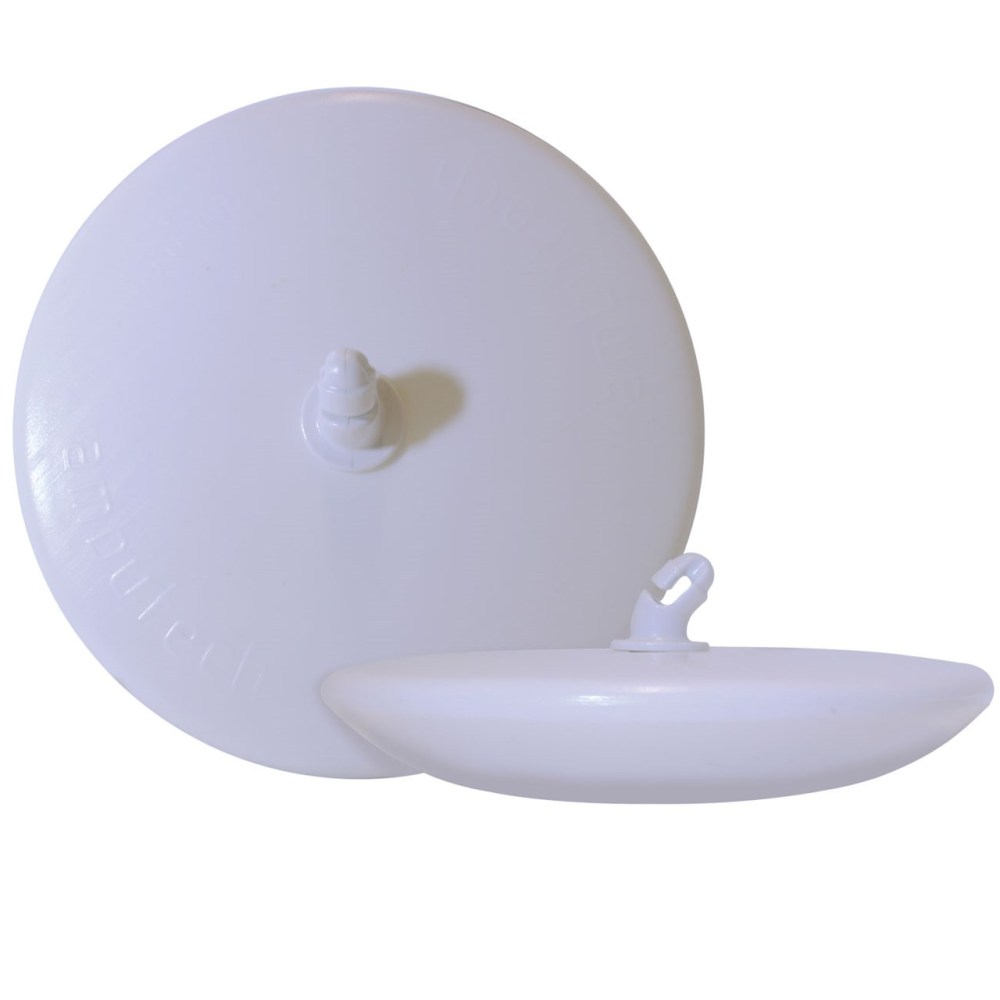
1. Dakota disc tip — the one for sand, snow, grass, and gravel. About $11. What it is: a wide, flat plastic disc, 6 inches (15 cm) across — by far the biggest footprint on this page. What it’s for: soft and loose ground where every other tip digs in, punches through, or snags. The disc spreads the cane’s contact across the surface, so it skims over beach sand, snow, grass, and pea gravel instead of plowing them. Who picks it: beach walkers, snow-belt travelers, hikers, and anyone whose route crosses a park, a playground, or an unpaved yard. The honest limits, straight from the maker’s listings: it is not designed for constant use on hard surfaces — cement, asphalt, and concrete will chew it and it tells you little there — so treat it as a swap-on tip for terrain days, not a daily driver. It is hook-style only, and it does not fit Slimline graphite, telescopic graphite, or aluminum symbol canes. Prices: $10.95 at MaxiAids (the white is listed in stock; the red was backordered in October 2026), $11.39 at Low Vision Supply, £13 at RNIB.
2. High-mileage tip — the marshmallow shape that lasts two to three times longer. About $5. What it is: a marshmallow-profile tip molded from an abrasion-resistant engineered polymer instead of plain nylon. What it’s for: exactly the marshmallow’s job — two-point touch — without the marshmallow’s fast wear on rough concrete. Who picks it: high-mileage walkers (the name is literal) who like how a marshmallow feels but are tired of replacing it. Prices: $4.90 in hook style at MaxiAids, $5.21 at Independent Living Aids. One naming trap, flagged plainly: there is also a threaded rolling-ball high-mileage version at about $16 — that is a different tip (threaded, rolling), not a “threaded hook-style” version of this one. Threaded and hook-style are different fittings; no tip is both.
3. Pathfinder 360 — the ball that rolls in every direction. About $40–41. What it is: Ambutech’s 2-inch rolling ball with a unique roller system, steel bearings, and a self-cleaning shield, made from ultra-high-molecular-weight material for long wear. What it’s for: constant contact without the compromise of the standard rolling ball (below), which rolls side to side but not forward and back — the Pathfinder rolls wherever the cane goes, so direction changes stay smooth instead of scraping. Who picks it: constant-contact travelers who found the standard ball’s one-axis roll limiting, and anyone who wants the longest-wearing roller Ambutech makes. It is hook style only. Prices — and a correction to this page’s earlier edition, which called the tip-only price unconfirmed: it is confirmed now, at $40.79 at LS&S and $39.99 at MaxiAids. That makes it the priciest standalone tip here; it is also sold bundled on graphite canes at about $69–78. Full disclosure, because this site practices what it preaches: the Pathfinder 360 is one of the founder’s own favorites — his everyday setup is a NO-JAB cane with a Pathfinder 360 on it, and the classic 2-inch roller ball below is his other favorite. We’d list both either way; the research above is why.
4. Ceramic tip — the information champion. About $16–18. What it is: a small hard ceramic half-sphere. What it’s for: feedback — the best audio and tactile transmission of any tip sold. On tile, polished concrete, and hard floors it rings so clearly that experienced travelers describe hearing doorways and wall lines in it. It also wears very slowly. Who picks it: travelers who read the world by sound as much as by touch, mostly on hard, smooth surfaces; rough asphalt is hard on it, and Ambutech does not recommend it for children. It comes in both hook style ($16.90 at MaxiAids; $17.62 at Independent Living Aids) and 8mm threaded ($15.95 at MaxiAids; $17.62 at LS&S and Independent Living Aids) — same tip, two fittings, check yours. One buying trap: some listings around $18 are not a standalone tip at all — they are a short cane with a ceramic tip already fixed on it. That’s a different purchase from the Ambutech ceramic cane tip above; read the listing’s title twice before paying.
5. Jumbo roller tip — the 2.5-inch disc that eats cracks. About $13. What it is: a rolling disc 2.5 inches (6.4 cm) across, in durable polyethylene — a wheel, not a ball. What it’s for: constant contact over broken pavement, cobbles, and wide cracks that swallow narrower tips; the big diameter bridges gaps instead of dropping into them. Who picks it: constant-contact users on rough urban terrain — it’s also the tip Ambutech pairs with its rigid fiberglass cane for exactly that work. It exists in both hook style ($13.02 at Independent Living Aids; $12.25 at MaxiAids) and slip-on style ($13.02 at Independent Living Aids) — fitting by fitting, below.
6. Metal glide tip — the dime that skates. 8mm threaded. What it is: a one-inch stainless steel disc with a rounded edge — the “dime tip.” What it’s for: the lowest-friction glide here, skimming smooth floors with almost no drag and strong audio feedback of its own; rated for two-point touch. Who picks it: travelers on smooth indoor and paved surfaces who want lively, sensitive feedback and a tip that lasts — and owners of Slimline and telescoping canes, because of its fitting: Ambutech sells the metal glide in 8mm threaded, the screw-in fitting those slim canes use. Price: AU$14 for the threaded tip at Vision Australia; a U.S. threaded price was not pinned down in this research pass, so we won’t dress the Australian figure up as one. On rough ground, know the trade: metal on coarse pavement is loud and chattery.
7. Rover free-wheeling tip — the little wheel. About $13.59. What it is: a 3-inch rubber wheel on a hook-style mount. What it’s for: being pushed forward over rough ground, like a tiny wheelbarrow wheel. Who picks it: honestly, few people — tip guides note it doesn’t suit the standard sweeping motion, and its feedback is limited, so it’s a poor match for travelers with little or no vision. It’s listed here so the shelf is complete and because you may meet it in catalogs: $13.59 in hook style at MaxiAids and Hearmore. Know what it is; most readers should pass.
Then, the well-known rollers
8. Rolling ball tip (2-inch / 50 mm) — the long-sidewalk standard. About $9–10. What it is: a 2-inch ball on a roller bearing with a protective shield. What it’s for: constant contact on sidewalks and pavement — more surface and more crack-bridging than the rolling marshmallow. Who picks it: constant-contact walkers on mostly urban routes; it’s the second of our readers’ favorites for a reason. Know its one limit, because the Pathfinder exists to fix it: the standard ball rolls side to side; it does not roll in any direction. Prices: $9.59 at MaxiAids (hook and slip-on), $10.23 slip-on at Independent Living Aids, $8 in the Wisconsin Council of the Blind’s store catalog. One price conflict, shown rather than hidden: the AwareWolf Gear roller ball tip — the colored 2-inch balls made for the All Terrain Cane, compatible with other 1/2″ slip-on canes — was listed at $18.95 at LS&S and $14.95 at awarewolfgear.com in the same research pass. Same tip, two prices: check AwareWolf direct before paying the higher one. And if you see it at LS&S for $29.95, that listing is a bundle, not the single tip — don’t compare it against single-tip prices.
9. Rolling marshmallow tip — the famous one. About $10–12. What it is: the marshmallow’s cylinder shape with a built-in protected bearing, in UHMW polyethylene, so it rolls instead of tapping. What it’s for: constant contact with a lighter, narrower roller than the ball — it rolls over cracks and even snow that stop a tapping tip, and it’s the tip the NO-JAB ships with. Who picks it: the largest group of constant-contact users, and anyone whose wrists feel the rolling ball’s extra weight over distance. Prices by fitting: hook style $10.95–$11.66; slip-on style $10.95–$11.66. And for slim-cane owners, the 8mm threaded rolling marshmallow is $11.66 at LS&S, listed as fitting the Slim Line SGS5020 and the telescoping TGS5030 — a threaded tip whose listing names its canes, which is exactly how every tip listing should read.
10. Marshmallow tip — the classic tapper. About $3.50. What it is: a one-inch nylon cylinder, stationary (it doesn’t roll), named for the shape. What it’s for: two-point touch — clean, honest feedback with very little weight at the end of the cane. Who picks it: two-point-touch travelers, and nearly everyone at some point — it’s the tip most canes ship with. Its one flaw is wear: rough concrete eats it, and a worn-flat marshmallow starts catching on cracks it used to ride over. Experienced users buy multiples and treat swapping as routine maintenance. Prices: about $3.50 generally; $2.69 hook style at MaxiAids; $5.02 slip-on at Independent Living Aids. If you like it but burn through it, scroll back up to the high-mileage tip — that’s its direct upgrade.
And the basics most people start with
11. Pencil tip — maximum sensitivity, minimum tip. About $3. The slimmest tip made: a narrow nylon point for two-point touch, with nothing between the ground and your hand — cracks, seams, and surface changes arrive undiluted. The trades are durability and forgiveness: a slim point catches in rough cracks a fatter tip rides over, and wears quickly on coarse pavement. Prices: $2.69 slip-on at MaxiAids; $2.91 at LS&S and Independent Living Aids.
12. Ball tip (stationary, slip-on) — the quiet budget option. About $3.50–3.91. A plain slip-on ball that doesn’t roll — the stationary cousin of the rolling ball, uncommon but cheap and simple, at $3.91 at LS&S and $3.65 at MaxiAids. Plain slip-on senior cane tips run about $3.50. At these prices, the experiment costs less than the coffee you spill learning a new tip — which is not an argument for these two so much as for trying any second tip on the cane you already own.
13. HiLite colors — make the tip yours. Many Ambutech tips — pencil, rolling ball, jumbo roller, high-mileage, rolling marshmallow — can be special-ordered with a HiLite colored cap: blue, green, orange, pink, or purple (RNIB takes these as special orders). A U.S. dollar price for the HiLite option was not confirmed in our research, so it’s flagged rather than guessed. Same idea as the HiLites canes and colored kiddie grips on the canes page: the tool you carry everywhere doesn’t have to be anonymous.
A warning, with no buy link — because there isn’t one anymore. If an older guide sends you to Russell’s Aids for cane tips: that tip has been discontinued. Don’t hunt for leftover listings or pay collector prices for a consumable. Its old fans are best served by the current Ambutech equivalents above — tell us which Russell’s tip you loved and we’ll point to the closest match as community reports come in.
Will it fit your cane? The compatibility truth
Here is the rule this page will not print, because it isn’t true: “hook tips fit X, slip-on tips fit Y.” There is no universal hook-versus-slip-on rule. Compatibility is decided tip by tip and cane by cane, and the honest way to buy is to match the tip’s stated fitting to your exact cane model. What the listings actually say:
| The three fittings | Hook style clips onto the elastic cord inside folding mobility canes. Slip-on pushes over the cane’s bottom section. 8mm threaded screws into the shaft — the fitting Slimline and telescoping canes use. A tip is one of these, never two: there is no “threaded hook-style” tip. |
|---|---|
| Named examples | The threaded rolling marshmallow ($11.66, LS&S) names its canes: Slim Line SGS5020 and telescoping TGS5030. The Ambutech Slim Line ID cane (SGS5020) takes 8mm threaded tips only. The metal glide is sold in 8mm threaded. The Pathfinder 360 and the Dakota disc are hook style only. |
| Named exclusions | The Dakota disc’s own listing excludes Slimline graphite, telescopic graphite, and aluminum symbol canes. When a listing names exclusions, believe them — and when it names no fitting at all, don’t buy it until the seller answers. |
| Before you order | Find your cane’s maker and model (it’s the step everyone skips), then buy the tip whose listing states that fitting — ideally that model. Ordering the wrong fitting is the single most common mistake in this category, and it is avoidable in one minute. |
The blind-specific details
| Constant-contact technique | Pathfinder 360 for any-direction rolling, rolling ball for side-to-side, jumbo roller for broken ground, Dakota disc for soft ground, rolling marshmallow for the lightest roll. The tip never leaves the ground, so it must roll or glide — tapping tips drag and catch. |
|---|---|
| Two-point touch technique | Marshmallow is the classic match; pencil is the maximum-sensitivity match; high-mileage is the marshmallow that lasts; ceramic works for tappers who mostly travel hard, smooth floors; metal glide skates for threaded-cane owners. |
| Sound as information | Ceramic is the loudest, clearest talker on hard floors. Metal glide is the loud one outdoors — on rough pavement, that’s noise, not signal. |
| Watch out for | A worn tip lies to you gradually — catching, dragging, going quiet — so replace on a schedule, not on a failure, if your routes are rough. Keep one spare tip wherever you keep spare batteries. And check the fitting against your cane model before ordering — see the compatibility section above. |
One more, from the community: the Omni Sense tip
Sam Seavey of The Blind Life — the blind community’s most-watched gear reviewer — gives the Omni Sense cane tip its own spotlight (“One Tip To Rule Them All”) and a follow-up challenge video at a skatepark: a multi-directional, all-terrain tip built to roll over ground that stops a standard roller. His long-term verdict wasn’t captured in our research, so it’s flagged as featured-not-yet-judged — but when the community’s cane-tip guide (his “All About the White Cane Tip,” 28,000 views) walks through marshmallow, ball, and Dakota Disk by situation, the Omni Sense is the newer name on that same shelf. If your routes mix pavement, gravel, and broken ground in one walk, it’s the tip to ask your cane’s maker about — after checking the fitting rules above, which apply to it like everything else.
The gap this page exists to fill: our research swept #BlindTok — 1.8-million-follower reviewers, O&M instructors, cane creators with hundreds of thousands of followers — and found no creator anywhere doing hands-on cane-tip demos: no Dakota disc on sand and snow, no marshmallow roller on rough pavement, no Pathfinder 360 on gravel. Tip knowledge lives in retailer listings and a handful of YouTube videos, which means the most ground-contact decision in a blind traveler’s kit is the one nobody demonstrates. This page is the demonstration in words — every major tip above is matched to its ground and technique — and it’s flagged here as a standing content opportunity: the first creator to film tips on terrain will own the niche, and this page will link them when they do. One prototype to watch, flagged as not yet buyable: the Sensaball cane tip, a tactile-feedback tip demo’d on YouTube (@lifeishowyouzeeit) with a Kickstarter launched in October 2026.
- The lineup, in page order
- Dakota disc (~$11), high-mileage (~$5), Pathfinder 360 ($39.99–$40.79), ceramic (~$16–18), jumbo roller (~$13), metal glide (8mm threaded; AU$14 at Vision Australia), Rover (~$13.59), rolling ball (~$9–10), rolling marshmallow (~$10–12), marshmallow (~$3.50), pencil (~$3), stationary ball (~$3.65–$3.91).
- Best feedback
- Ceramic — best audio and tactile feedback in the lineup, per Ambutech’s own positioning and blind tip guides.
- Wear
- Every tip is a consumable. Marshmallow and pencil wear fastest on rough ground; high-mileage lasts 2–3× nylon; ceramic and metal glide wear slowest. Budget for replacements, not just the first tip.
- Price conflicts, shown
- AwareWolf roller ball: $18.95 at LS&S vs. $14.95 at awarewolfgear.com in the same research pass; LS&S’s $29.95 listing is a bundle, not the single tip.
- Discontinued
- Russell’s Aids cane tips — discontinued; warning only, no buy link.
Ready to buy?
You’ve read the blind-specific part first — that’s the point of this page. The sellers are the exit:
target="_blank" rel="noopener", affiliate link
target="_blank" rel="noopener", affiliate link
target="_blank" rel="noopener", affiliate link
target="_blank" rel="noopener", affiliate link
target="_blank" rel="noopener", affiliate link
target="_blank" rel="noopener", affiliate link
target="_blank" rel="noopener", affiliate link
target="_blank" rel="noopener", affiliate link
target="_blank" rel="noopener", affiliate link
target="_blank" rel="noopener", affiliate link
target="_blank" rel="noopener", affiliate link
target="_blank" rel="noopener", affiliate link
Back to the white canes page — every style, type, and model compared (opens in a new tab)
Blind-owner reviews
No reviews yet — write the first one. Every review is read by a human before it appears.